Key takeaways
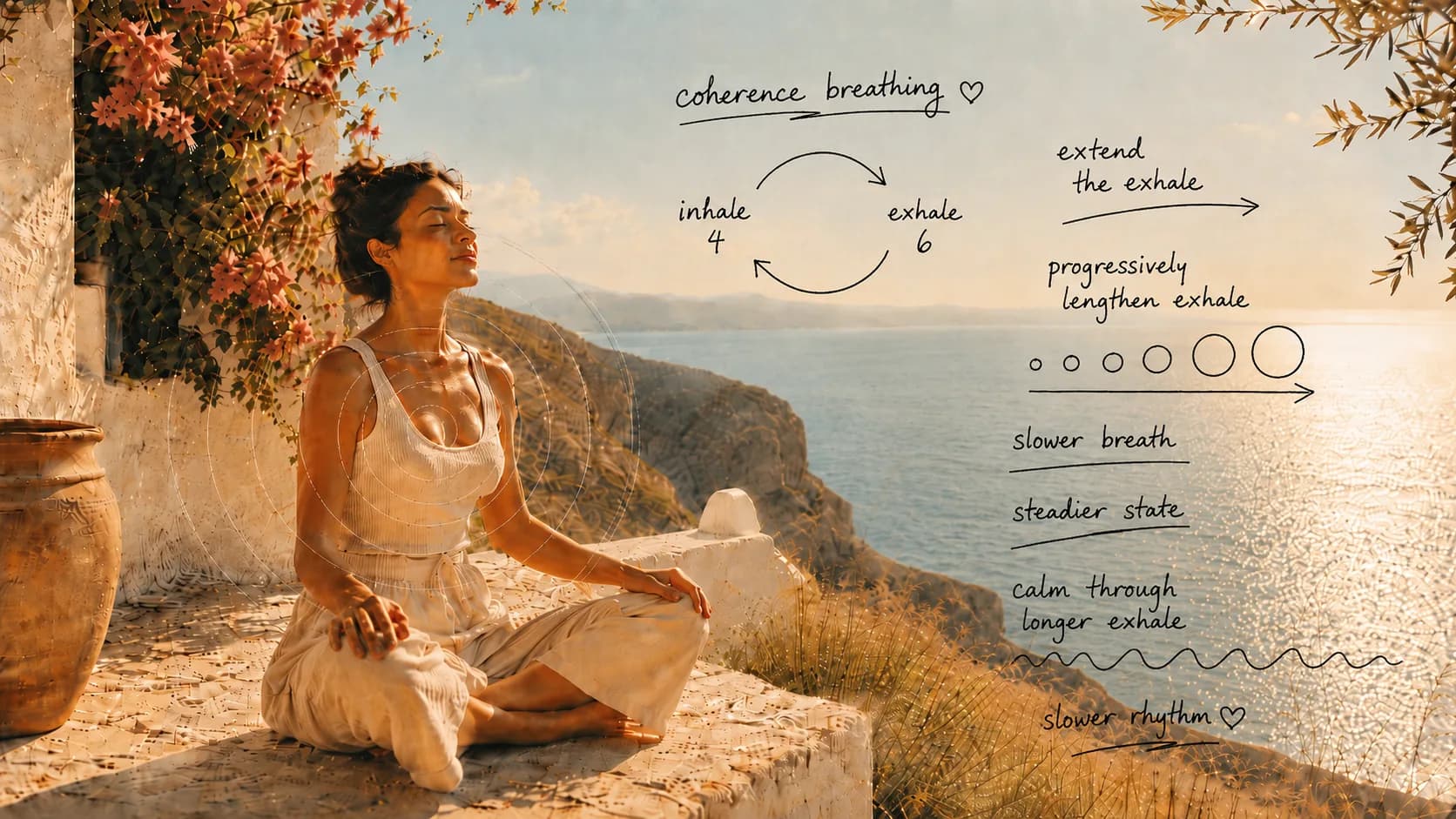
- 1Slow breathing near 0.1 Hz—about six breaths per minute—often increases in-session HRV through respiratory sinus arrhythmia and baroreflex resonance.
- 2A 5.5-second inhale plus 5.5-second exhale is about 5.45 breaths per minute, a practical group starting pace rather than a universal optimum.
- 3A high paced-breathing HRV reading does not by itself prove that baseline vagal tone or health improved.
- 4Compare resting measurements under consistent conditions and interpret trends alongside sleep, symptoms, medication, and training load.
What HRV measures
Heart rate variability is variation in the time between successive heartbeats. A heart beating 60 times per minute does not normally place every beat exactly one second apart. The pattern of those intervals reflects several interacting control systems, including breathing, baroreflex activity, autonomic input, posture, and metabolic demand.
HRV is not one number. Time-domain metrics such as RMSSD, frequency-domain measures, and device-specific readiness scores answer different questions. Consumer wearables also use different sensors and processing. Compare the same metric, device, position, and time of day rather than treating all HRV values as interchangeable.
Why slow breathing makes HRV rise
Heart rate usually accelerates during inhalation and slows during exhalation, a pattern called respiratory sinus arrhythmia. Breathing also changes intrathoracic pressure and blood pressure, which engages the baroreflex. Near the cardiovascular system’s resonance range, those oscillations can align and produce a large heart-rate swing with each respiratory cycle.
That is why HRV can rise immediately during paced breathing. The increase is partly a measurement of the imposed respiratory rhythm. The session can still be useful; interpret the immediate HRV rise as practice feedback, then use repeated resting measurements for longer-term context.
Why Auralize starts near 5.5 BPM
One cycle of 5.5 seconds in and 5.5 seconds out lasts 11 seconds, or about 5.45 breaths per minute. That sits inside the range commonly used for resonance-frequency and HRV-biofeedback practice. Exact resonance frequency varies between people and can be estimated by comparing several slow rates while monitoring HRV, breathing comfort, and the smoothness of the heart-rate oscillation.
Coherence vs resonance frequency
“Coherence breathing” is commonly used for slow, even breathing near five to six breaths per minute. “Resonance-frequency breathing” is more specific: it aims to identify the individual rate that produces the strongest baroreflex-related oscillation. A fixed coherence pace is easier to deliver in a general app; individualized biofeedback requires measurement and should not be implied by a universal preset.
What may change with practice
HRV-biofeedback research supports improvements in some stress- and performance-related outcomes, but protocols, populations, and outcome measures vary. Some people also see resting HRV trends rise with consistent practice. The evidence does not justify promising that everyone’s baseline will increase within a fixed number of weeks.
To look for a baseline change, measure at rest before the day’s breathing practice, ideally at the same time and in the same position. Review a weekly trend rather than one reading. Acute illness, alcohol, sleep loss, hard training, menstrual-cycle phase, medication, and measurement artifact can all move the number independently of breath training.
How to practice
Use a quiet nasal inhale and relaxed exhale without deliberately filling or emptying the lungs. Start with five minutes near six breaths per minute. If the pace creates air hunger, reduce breath depth rather than taking larger breaths. If it remains uncomfortable, return to ordinary breathing and try a slightly faster pace later.
Limits and safety
HRV is associated with health and adaptability at a population level, but it is not a diagnosis and “higher” is not always better in every rhythm or clinical context. Irregular heart rhythms can also make consumer readings misleading. People with known arrhythmias or concerning palpitations should use clinical guidance rather than interpreting an app or wearable score on their own.