All articles
Coherence Breathing and HRV: What the Science Actually Says
ScienceHRVRecovery

Coherence Breathing and HRV: What the Science Actually Says

One breathing rhythm — 5.5 breaths per minute — produces measurable changes in heart rate variability. Here's what the research shows and how to use it.

Auralize Editorial TeamAuralize Editorial Team
11 min read

Your heart is not supposed to tick like a metronome. Even when your resting heart rate says 60 beats per minute, the beats are not landing exactly one second apart. One gap might be 920 milliseconds, the next 1040, the next 970. That tiny beat-to-beat movement is heart rate variability, or HRV. [1]

The easiest way to picture it is as spacing, not speed. Low HRV looks like evenly spaced drum hits: beat, beat, beat. Higher HRV looks more elastic: the heart speeds up slightly, slows down slightly, then speeds up again as your nervous system responds to breath, pressure, posture, and stress. A healthy heart is not rigid. It is adjustable.

Visualize HRV

Low variability

Same gap each time

Higher variability

Shorter and longer gaps

The dots above represent heartbeats on a four-second timeline.

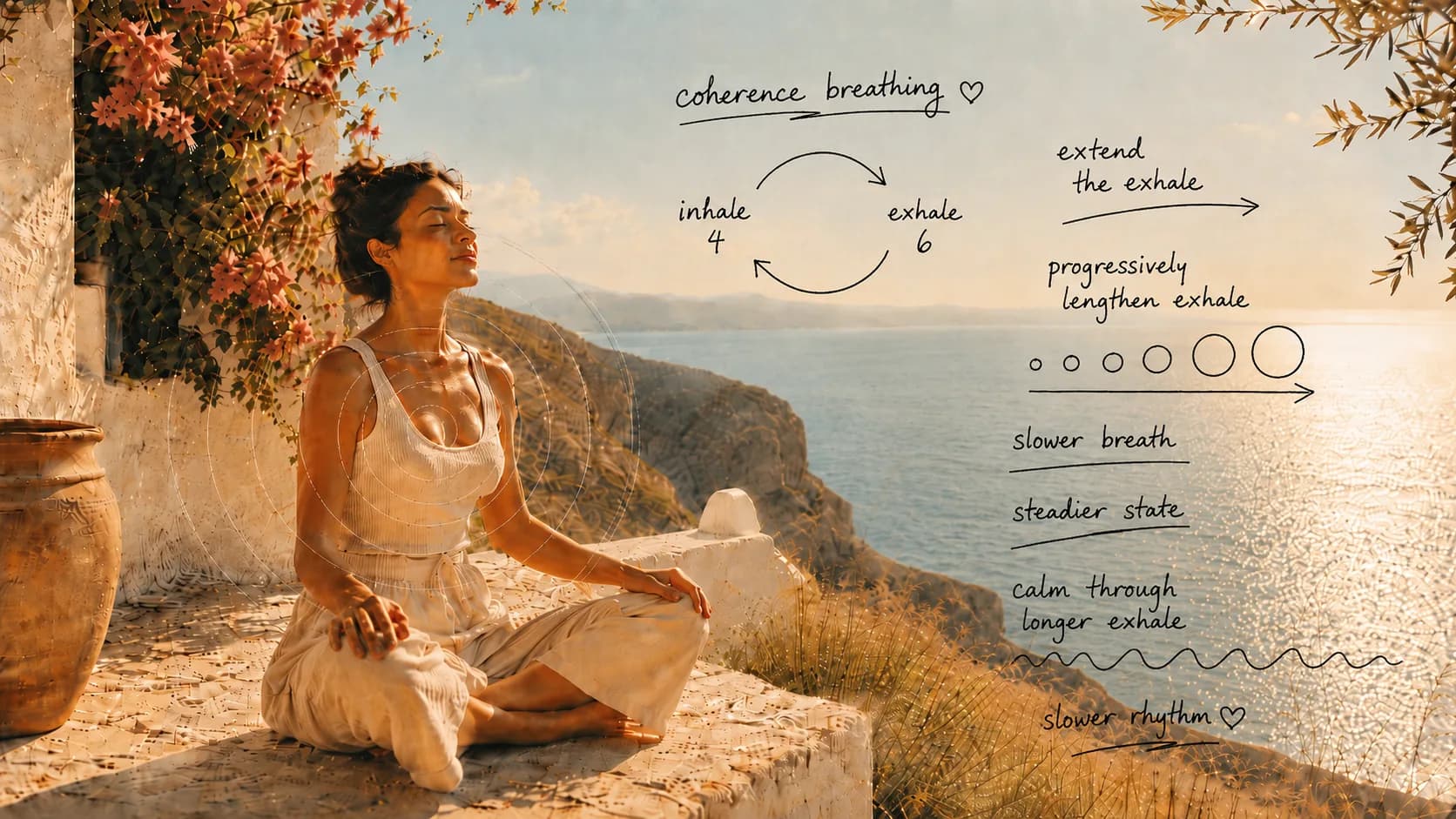
Coherence breathing matters because breath is one of the few levers you can use voluntarily to influence that rhythm. At roughly 5.5 breaths per minute, inhaling and exhaling in smooth equal waves, breathing begins to synchronize with heart-rate oscillation. The result is not just a calmer feeling. It is a measurable increase in HRV during the session, and with regular practice, a trainable pathway for recovery and stress resilience.

What HRV Actually Measures

HRV is the variation in timing between individual heartbeats. High variability does not mean your pulse is erratic or unstable. It means the autonomic nervous system can quickly adjust the heart's rhythm to match what the body needs. Low variability means the heart is operating in a narrower, more rigid range. [6]

The science

HRV reflects the activity of the autonomic nervous system — specifically the balance between the sympathetic (“fight or flight”) and parasympathetic (“rest and digest”) branches. The parasympathetic branch, mediated by the vagus nerve, slows the heart. When it is active, beat-to-beat intervals lengthen. When the sympathetic branch dominates — during stress, poor sleep, illness, or overtraining — intervals shorten and become more uniform. [1] Higher HRV therefore indicates greater parasympathetic tone, which is associated with better recovery, lower inflammation, improved cognitive function, and reduced cardiovascular risk. [3]

The medical standard for HRV measurement was established by the European Society of Cardiology in 1996. [1] Since then, an enormous research literature has linked HRV to health outcomes — and to modifiable behaviours that change it.

Resonance Frequency: Why 5.5 Breaths Per Minute

Every individual has a respiratory rate — around 5.5 breaths per minute on average — at which their cardiovascular system enters what researchers call "resonance." At resonance frequency, the oscillations of the respiratory system (breathing in and out) couple precisely with the natural oscillations of the cardiovascular system, producing maximum-amplitude swings in heart rate with each breath cycle. [2]

Psychologist Paul Lehrer at Rutgers University has spent three decades studying this phenomenon. His work established that slow, rhythmic breathing at or near one's resonance frequency produces the largest acute increases in HRV of any non-pharmacological intervention. [2] [5] The effect is immediate and measurable in the same session.

Breathing at the resonance frequency maximises heart rate oscillations and stimulates both the baroreceptors and the respiratory system, providing exercise for the heart rate control system and causing it to become stronger, with greater amplitude and, we hypothesise, greater variability.

Paul Lehrer & Richard Gevirtz, Frontiers in Psychology (2014)

The standard coherence breathing protocol — 5.5 breaths per minute, equal inhale and exhale — approximates the average resonance frequency across adults. [4] Some individuals resonate at slightly higher or lower rates, which is why HRV biofeedback protocols individualise the frequency. But 5.5 breaths per minute is close enough to produce clear effects in most people without any specialised equipment.

What Regular Practice Does Over Time

The acute effect — elevated HRV during and immediately after a coherence session — is consistent and well-replicated. [4] But the more interesting finding from Lehrer's longitudinal studies is that regular practice produces lasting changes in resting HRV. [8] The heart rate control system appears to adapt, similar to cardiovascular fitness training, becoming more responsive and efficient over weeks of practice.

Effects on anxiety and performance

HRV biofeedback — training with coherence breathing while watching your HRV in real time — has been studied extensively in clinical populations and athletes. In male athletes, eight weeks of HRV biofeedback training produced significant reductions in competitive anxiety and changes in EEG alpha asymmetry associated with positive emotional processing. [7] In clinical studies, coherence breathing protocols have shown effects comparable to medication for anxiety disorders, with none of the side effects. [9]

The vagal connection

The mechanism runs through the vagus nerve — the primary channel of parasympathetic communication between the brain and the body. Slow breathing stimulates the baroreceptors (pressure sensors in the aorta and carotid arteries), which signal the brainstem to increase vagal outflow. [2] Stephen Porges' polyvagal theory frames vagal tone as the foundation of social engagement, emotional regulation, and felt safety. [10] Coherence breathing is, in this framing, a direct method for increasing vagal tone — one of the main physiological signals HRV research tries to capture. [11]

Train coherence

Coherence Breathing Shift

5–20 min

Auralize guides you through the 5.5 breath rhythm with real-time pacing and time-of-day adaptive environments. Start with five minutes.

How to Practice Coherence Breathing

The protocol is disarmingly simple. Breathe in through your nose for 5.5 seconds, breathe out through your nose for 5.5 seconds. Repeat without pausing between inhale and exhale. That is one breath cycle. Continue for five minutes minimum — ten to twenty minutes for training effects on resting HRV. [5]

The most common mistake is making it effortful. Coherence breathing should feel like a gentle, regular rhythm — not a forced extended breath hold or a dramatic expansion. The goal is smooth, uninterrupted oscillation. If you feel lightheaded or strained, your breaths are too large. Make them smaller and let the rate do the work. [2]

When to practice

Morning coherence breathing — before screens, before coffee, within the first hour of waking — establishes a parasympathetic baseline for the day and is often easiest to see in next-morning HRV measurements. Evening sessions, 60–90 minutes before sleep, accelerate the transition from sympathetic to parasympathetic dominance and improve sleep onset. [4] Even a single five-minute session mid-afternoon can offset the cortisol accumulation of a stressful day.

Consistency matters more than duration. Five minutes daily for eight weeks produces more adaptation than forty-minute occasional sessions. [8] Treat it like a training block, not a crisis tool.

Start your practice

Build Your HRV with Coherence Breathing

Auralize's coherence breathing shifts adapt to your time of day, guide you through precise 5.5-second cycles, and make the practice easy to sustain daily.

Citations

  1. [1]Task Force of the European Society of Cardiology and the North American Society of Pacing and Electrophysiology (1996). Heart rate variability: standards of measurement, physiological interpretation and clinical use. Circulation. PMID: 8598068.
  2. [2]Lehrer PM, Gevirtz R (2014). Heart rate variability biofeedback: how and why does it work? Frontiers in Psychology. PMC4104929.
  3. [3]Thayer JF, Åhs F, Fredrikson M, Sollers JJ, Wager TD (2012). A meta-analysis of heart rate variability and neuroimaging studies: implications for heart rate variability as a marker of stress and health. Neuroscience & Biobehavioral Reviews. PMID: 22178086.
  4. [4]Zaccaro A, Piarulli A, Laurino M, Garbella E, Menicucci D, Neri B, Gemignani A (2018). How Breath-Control Can Change Your Life: A Systematic Review on Psycho-Physiological Correlates of Slow Breathing. Frontiers in Human Neuroscience. PMC6137615.
  5. [5]Lehrer PM et al. (2003). Resonance frequency biofeedback training to increase cardiac variability: rationale and manual for training. Applied Psychophysiology and Biofeedback. PMID: 14608830.
  6. [6]Shaffer F, Ginsberg JP (2017). An Overview of Heart Rate Variability Metrics and Norms. Frontiers in Public Health. PMC5624990.
  7. [7]Dziembowska I, Izdebski P, Rasmus A, Brudny J, Magdyś M, Perkowski R (2016). Effects of heart rate variability biofeedback on EEG alpha asymmetry and anxiety symptoms in male athletes. Applied Psychophysiology and Biofeedback. PMID: 26846763.
  8. [8]Lehrer P, Vaschillo E, Lu SE, Eckberg D, Edelberg R, Shabo E, Hamer R, Cannon R, Coppola L (2006). Heart rate variability biofeedback: effects of age on heart rate variability, baroreflex gain, and asthma. Chest. PMID: 16304247.
  9. [9]Gevirtz R (2013). The promise of heart rate variability biofeedback: evidence-based applications. Biofeedback. doi:10.5298/1081-5937-41.3.01
  10. [10]Porges SW (2007). The polyvagal perspective. Biological Psychology. PMID: 17049418.
  11. [11]Laborde S, Mosley E, Thayer JF (2017). Heart rate variability and cardiac vagal tone in psychophysiological research – recommendations for experiment planning, data analysis, and data reporting. Frontiers in Psychology. PMC5311784.

Auralize does not replace medical care. Breathwork should always feel safe and voluntary. Consult a healthcare professional before beginning any new respiratory training program.