Key takeaways
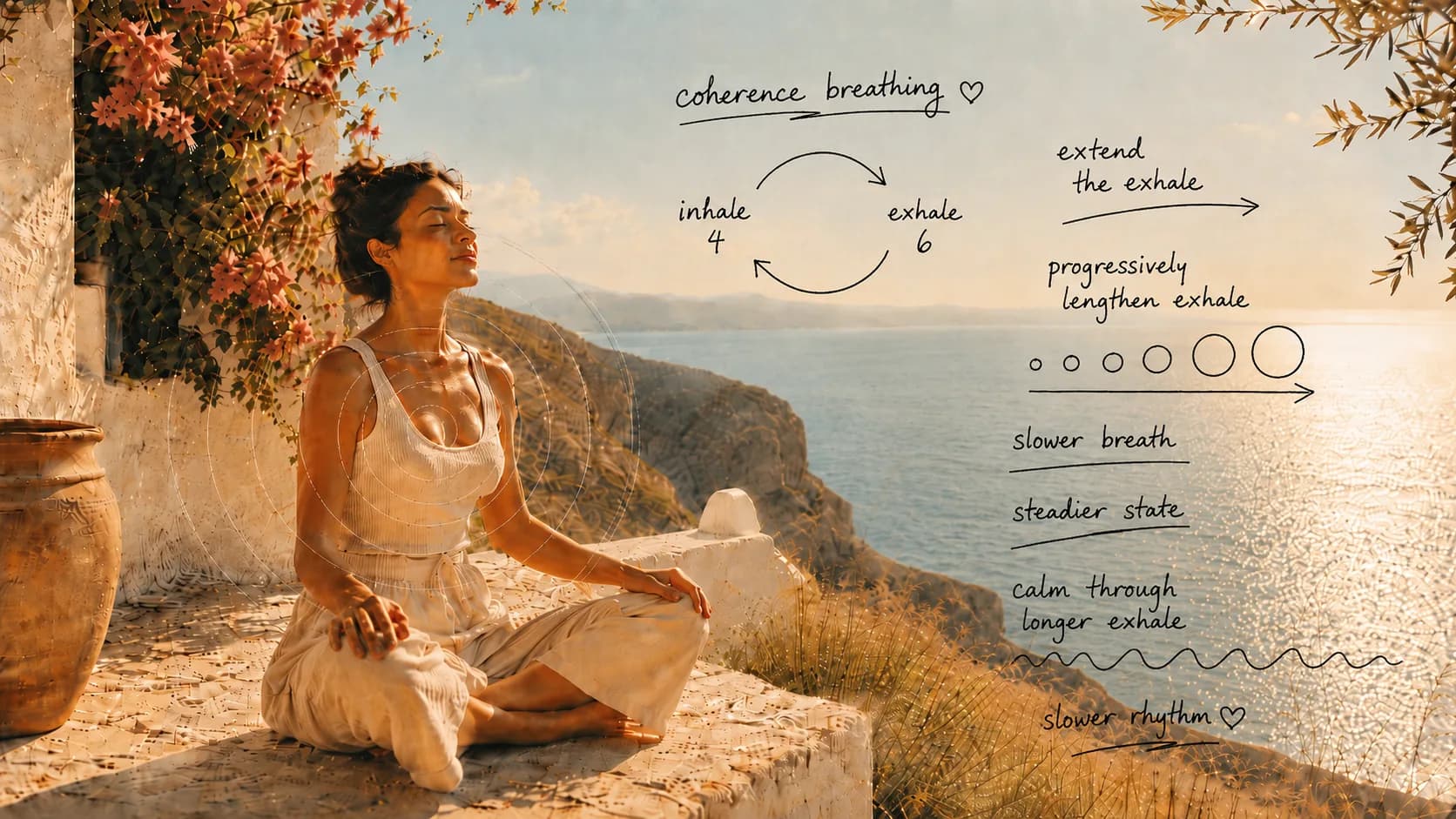
- 1Coherence breathing is paced breathing near the cardiovascular resonance frequency — about 5.5 BPM.
- 2It can produce a large respiratory-linked heart rate variability response during practice.
- 3Longer-term resting HRV changes vary between people and study protocols.
- 4It is the workhorse of HRV training, recovery breathwork, and daily nervous-system maintenance.
Why 5.5 breaths per minute matters
Coherence breathing sits at the cardiovascular resonance frequency: the rate at which respiratory, cardiac, and vascular oscillations synchronise. In most adults this rate is between 5 and 6 breaths per minute — Auralize uses 5.5. At the resonance frequency, blood pressure oscillations, heart rate oscillations, and breath align, producing the largest heart rate variability amplitude for a given practice. [2] [3]
This is not folk wisdom. It is what emerges from the mechanics of the baroreflex. Larger frames resonate slightly slower; smaller frames slightly faster. If 5.5 feels off, try 5 or 6.
When to use it
Coherence is often practiced regularly. HRV commonly changes during the session because breathing itself shapes the measurement; whether resting HRV changes over time depends on the person, dose, measurement method, and training context. Use it after training for recovery, before meditation as an onramp, in the evening as a gentle wind-down, or between meetings when box breathing feels too intense.
A practical HRV-biofeedback pattern
Slow paced breathing is widely used in HRV biofeedback because it can amplify respiratory sinus arrhythmia near an individual's resonance frequency. Read the in-session rise as useful feedback from the practice rhythm, then watch longer-term trends separately. [1]
How to practice
Breathe through the nose, both directions. Equal counts: 5.5 seconds in, 5.5 seconds out. Keep the breath light — this is not deep breathing. Shoulders down, jaw soft, belly moving first. The whole point is to make it effortless enough that you can sustain fifteen minutes.
What to track over time
Track comfort, adherence, resting respiratory rate, and HRV under the same measurement conditions. In-session HRV often rises immediately, while durable resting changes depend on the person, dose, and measurement context. Look for your own trend over several weeks.