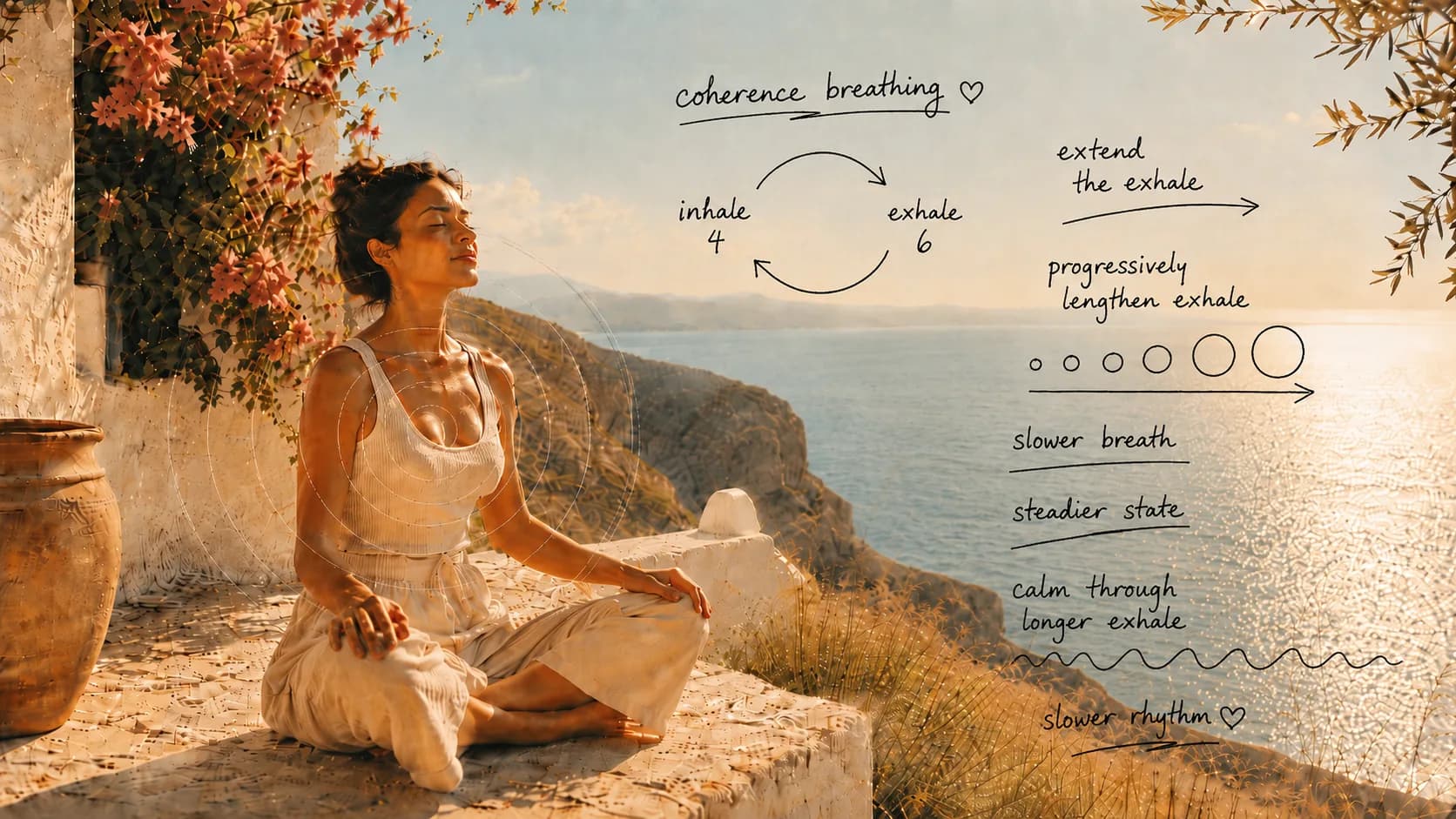
Key takeaways
- 1Slow Breathing Mastery teaches access to slow paced breathing, not a forced lower resting rate.
- 2The resting breath-rate baseline helps choose a starting level that does not overreach.
- 3The phase arc moves from comfortable rhythm into longer exhales and coherence practice.
- 4Progress is based on completed sessions across phase quotas, with a 7-day inactivity guard.
Why this program exists
Many people hear “slow breathing” and immediately try to breathe as slowly as possible. That usually creates tension. This program is designed for the opposite: make slow breathing feel accessible, repeatable, and calm enough that you can use it without turning the session into a performance test. Reviews of slow-breathing practice support the general downshift rationale, while also showing that protocols and outcomes vary. [1] [2]
The useful skill is control over rhythm. If your normal breathing pace is high, the first job is to find a slower pattern that still feels safe. If your baseline is already low, the job is maintenance and refinement rather than forcing the rate down further.
Why the progression is shaped this way
The program uses three phase quotas because slow breathing has two separate skills: comfort with the pace and comfort with the longer exhale. Early sessions protect the first skill. Later sessions add exhale-biased patterns and coherence so the breath can settle without becoming mechanical.
Auralize does not treat six breaths per minute as your new resting target. Coherence breathing is a practice rhythm, not a command for how your breathing should look all day. The progression is built to help you enter that rhythm more easily when you choose it. The HRV-biofeedback literature is why Auralize treats resonance-paced practice as a training target while still leaving room for each person to find a comfortable rhythm. [3] [4]
How Auralize keeps it personalized
The resting breath-rate assessment gives the app a starting signal. Higher baselines start with gentler balanced or lightly extended patterns before moving toward longer exhales. Lower baselines can spend more time in coherence because the app does not need to teach a basic slow-down first.
End-of-program tracking is most useful when measurements are taken under comparable conditions. Use the trend to watch familiarity, control, resting rate, and HRV without turning any single metric into the whole score.
How to use it well
Treat comfort and consistency as the score. If a longer exhale makes you pull air in sharply on the next inhale, the pattern is ahead of your current control. Complete sessions steadily, avoid long inactive gaps, and let the program move phases by logged practice rather than by calendar pressure.