Key takeaways
- 1Slow paced breathing can lower blood pressure during a session, and some studies report modest longer-term reductions; certainty and effect size vary.
- 2Breathing practice is an adjunct to validated care—not a replacement for medication, monitoring, exercise, sleep care, or dietary treatment.
- 3Measure at home with a validated upper-arm cuff and a consistent protocol; compare resting trends rather than the lowest value after one calming session.
- 4Severe readings or symptoms such as chest pain, neurological changes, fainting, or severe breathlessness need urgent medical guidance, not an app session.
What the evidence supports
Slow breathing has a plausible cardiovascular mechanism and a mixed but meaningful research base. Individual trials have reported lower blood pressure after regular device-guided or paced-breathing practice. Systematic reviews note variation in study quality, comparison groups, devices, and dosing. The appropriate conclusion is that slow breathing may provide a modest adjunctive benefit for some people—not that one rhythm reliably lowers every person’s pressure by a fixed amount.
A reading can also fall during a quiet session because the person has been seated, resting, and no longer talking. That acute change is useful but different from a sustained change in resting blood pressure across days. Longer-term claims should be based on repeated measurements under the same conditions and discussed with the clinician managing treatment.
The proposed mechanism
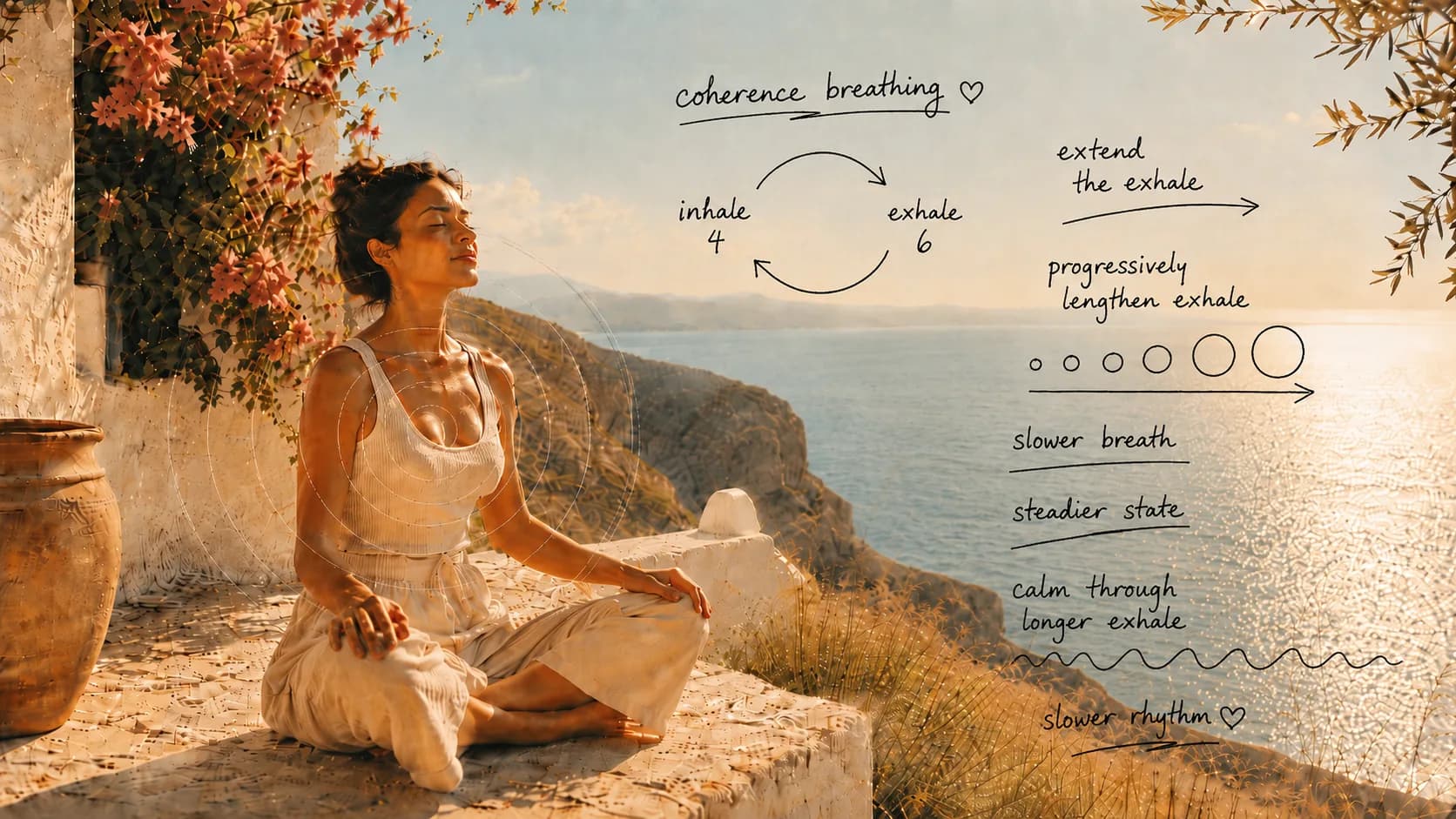
Breathing changes pressure inside the chest, venous return, heart rate, and beat-to-beat blood pressure. The baroreflex detects pressure changes and adjusts heart rate and vascular tone. Slow breathing near the cardiovascular resonance range can amplify these oscillations and may train baroreflex sensitivity over time. Relaxation and reduced respiratory effort may contribute as well.
Mechanism is not the same as clinical outcome. A large HRV wave during practice does not establish that hypertension has been treated. Hypertension has multiple causes and risk factors, many of which a breathing exercise cannot address.
A conservative practice
Sit with the back supported and breathe quietly at a comfortable pace near five to six breaths per minute. Keep inhale and exhale relaxed; there is no need for a breath hold or maximal lung volume. Start with five minutes. If the pace is easy and your clinician has no concerns, a ten- to fifteen-minute daily practice is a reasonable training format.
Stop if you become dizzy, faint, unusually short of breath, or develop chest discomfort. Auralize’s coherence pattern is a pacing aid, not a blood-pressure device and not a personalized prescription.
How to measure without fooling yourself
Use a validated upper-arm monitor with the correct cuff size. Follow the monitor’s instructions and your clinician’s measurement plan. Sit quietly beforehand, support the arm, avoid talking, and record more than one reading when advised. Compare weekly or clinician-defined averages rather than selecting the lowest value immediately after a calming exercise.
Medication and clinical care
Keep taking prescribed medication unless the prescriber changes it. Do not reduce a dose because a post-session reading is lower, and do not delay evaluation of persistently high readings. Breathing can sit beside established measures such as medication, physical activity, dietary changes, sleep-apnea assessment, reduced alcohol intake, and weight management where appropriate.
When medical care comes first
A breathing exercise is not an appropriate response to a possible hypertensive emergency or to new chest pain, weakness, confusion, vision change, fainting, or severe breathlessness. Follow local emergency guidance. People who are pregnant, have unstable cardiovascular disease, or become symptomatic during slow breathing should seek individualized medical advice before continuing.
Bottom line
Comfortable slow breathing is low-cost and may support blood-pressure care, especially when stress and respiratory pattern are relevant. Its strongest role is as a repeatable relaxation and self-regulation practice within a complete care plan. It should be measured honestly and never marketed as a cure.