
Key takeaways
- 1Basketball's clocks already create the breath windows: a 10-second free-throw window, the dead ball, the timeout, and the walk back on defense. You don't need to invent rituals — you need one repeatable breath for each window.
- 2The free throw is the cleanest reset: one quiet inhale on the catch, a longer exhale through the dribble routine, then release before the breath becomes a hold.
- 3Use one controlled exhale to mark dead balls, fouls, and made baskets as “previous play over,” then five 5.5-second coherence breaths in timeouts to recover HRV before the next possession.
- 4The on-court protocol works because the rhythm was already grooved off the court — nasal-only coherence breathing on shootaround days and light CO₂ tolerance work during the week.
- 5Auralize trains the same rhythm with the CO₂ Capacity Builder, then a coherence block, so the breath you reach for at the line is the one you have rehearsed.
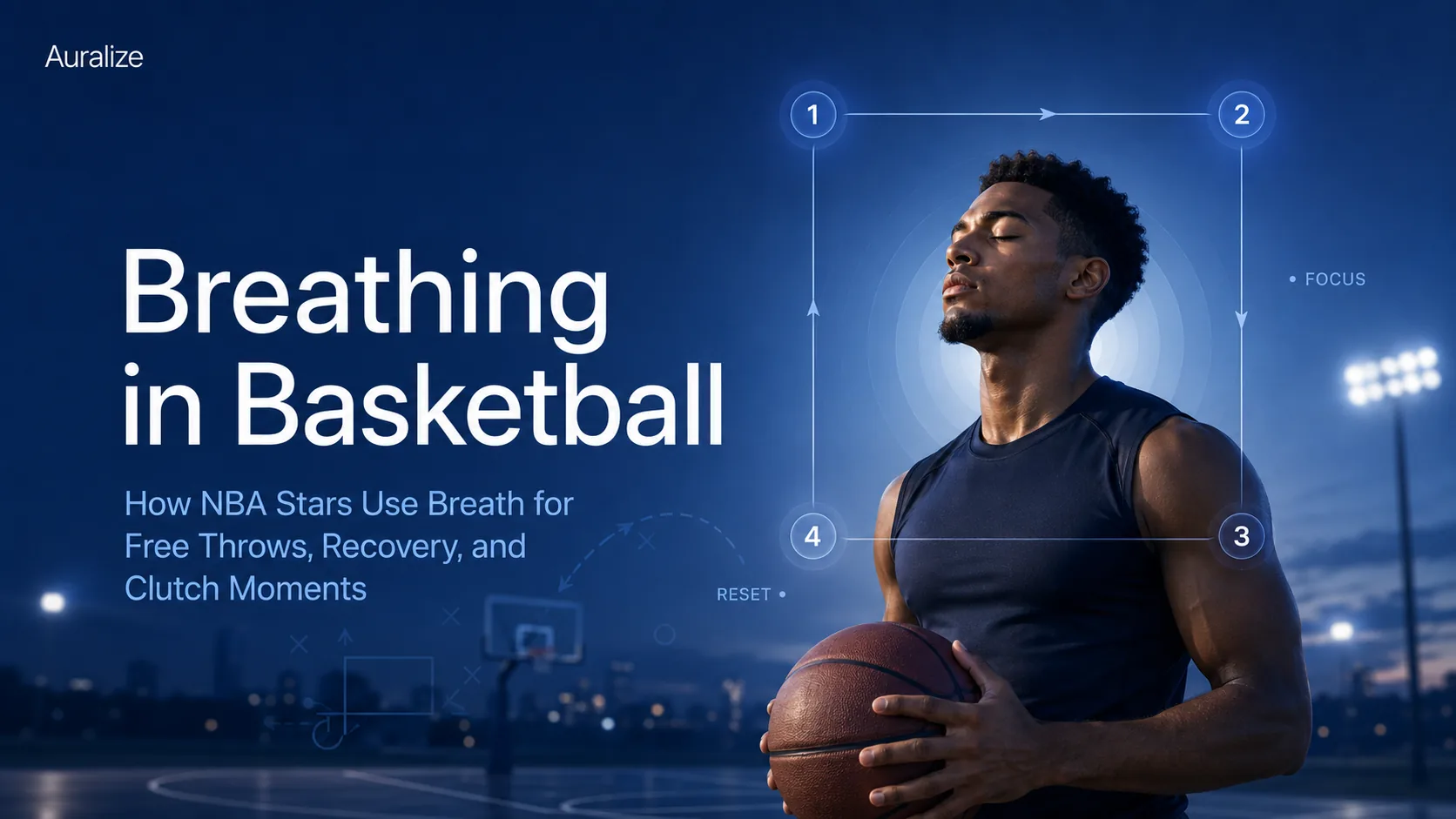
Breathing in basketball is not about adding a new ritual to a fast game. The game already gives you the windows — the free-throw line, the dead ball, the timeout, the walk back on defense — and a rehearsed breath simply fits inside each one. NBA regulation is four 12-minute periods. [1] Each possession is shaped by a 24-second shot clock. [2] A free throw gives the shooter up to 10 seconds after receiving the ball. [3] Those clocks matter because they create repeatable breath windows inside a game that otherwise feels rushed.
The Auralize angle is not that one breath makes you a better shooter by itself. The useful claim is smaller and more trainable: basketball repeatedly gives you moments to reset posture, attention, and breathing before the next action. If the breath is rehearsed, those moments become usable.
What basketball asks of the breath
Basketball is a court-based team sport with high physical, physiological, technical, and tactical demands across practice and competition. [4] A competitive-game study of experienced male players reported a mean heart rate near 90% of maximum, frequent accelerations and decelerations, and repeated body impacts during play. [5]
That matters for breathing because the next skill action often happens before the body feels fully settled. A player may sprint, absorb contact, get fouled, then step to the line with noise, fatigue, and score pressure still present. The breath routine is not a shortcut around skill. It is a way to make the next skill attempt start from a more organised state.
The science
Slow breathing is best used as autonomic support rather than a fixed heart-rate formula. Slow-paced breathing near resonance frequency can increase vagally mediated HRV and baroreflex sensitivity. [7] In basketball language: use the pause to steady the system before the next shot, read, or defensive possession.
The free throw is the cleanest window
Free throws are where routine matters most visibly. Mack's study on intercollegiate players found that changing the movements in a player's preshot routine significantly affected free-throw performance, while lengthening the routine time did not. [6] The lesson is practical: keep the routine consistent, and make the breath part of the routine instead of an extra thought.
Use whatever dribble pattern already belongs to you. Add one easy inhale as the ball settles and one longer exhale before the release. Eyes return to the target on the exhale. The shot still has to be made by mechanics, arc, touch, and repetition; the breath just gives those mechanics a cleaner start.
The basketball breath protocol
The protocol should fit real play. It needs to work after a hard possession, inside the 10-second free-throw limit, and during timeouts without pulling attention away from the coach.
1. Free throw
Receive the ball. Take one quiet inhale through the nose or mouth, whichever feels natural after contact. Let the exhale run longer as the dribble routine begins. Release before the breath becomes a hold. The cue is simple: exhale, see the target, shoot.
2. Dead ball or walk-up
After a whistle, turnover, foul, or made basket, use one controlled exhale while you find your matchup or spacing. Do not force a long count while the game is moving. One deliberate breath is enough to mark the previous play as over.
3. Timeout or bench window
Use five breaths at roughly 5.5 seconds in and 5.5 seconds out. This is the rhythm used in coherence and resonance-breathing work linked to HRV training. [7] Five breaths takes about 55 seconds, leaving space for the actual tactical message.
Test yourself
CO₂ Tolerance Test
60 secA guided slow-exhale baseline for how comfortably you control the breath as air hunger rises. It is not a shooting predictor, but it gives you a starting point for score-matched box breathing.
The training pattern that supports it
In-game breathing works best when it has already been trained off the court. Auralize uses two simple inputs for that: coherence breathing for the recovery rhythm, and box breathing matched to your CO₂ tolerance or BOLT result for calm under mild air hunger.
Start with coherence breathing at roughly 5.5 breaths per minute. Then add box breathing at the interval unlocked by your assessment. The holds create mild air hunger in a controlled setting, which gives you practice staying composed when the urge to breathe rises. [9]
The science
A 2024 systematic review and meta-analysis found that longer-term slow-paced breathing and breath-hold interventions were associated with improved physical sport performance, while also noting heterogeneous evidence and risk-of-bias limits. [8] Treat breath training as a support skill for composure and recovery rhythm, not as a substitute for shooting reps.
A sample four-week training arc
The arc below is a way to layer a phase-based Auralize program (CO2 Capacity Builder or Slow Breathing Mastery) inside a longer training block, with a baseline week before and a transfer week after. Auralize supplies the guided sessions; the rest is self-directed work that fits the same cadence.
Week 1 — baseline. Take the CO₂ tolerance test or the BOLT breathing test. Daily 10-minute coherence block at 5.5 seconds in and 5.5 seconds out. Three days a week, shoot 25 to 50 free throws with the same breath cue every time.
Week 2 — box breathing. Add a 10-minute box-breathing block at the interval Auralize unlocks from your result. Keep the free-throw routine unchanged. If the breath cue makes the shot feel slower or crowded, shorten it rather than adding more steps.
Week 3 — fatigue transfer. Add five sprint-to-line reps: short hard effort, walk to the line, one breath-led free throw. The goal is not to simulate a whole game; it is to practise finding the same cue while breathing and heart rate are elevated.
Week 4 — automaticity. Hold the volume. Retest at the end of the block and look for a trend, not a heroic number. The on-court target is that the breath cue appears before the shot without needing to be negotiated.
For the shooter who tightens up late
Late-game misses are not only a breathing problem. Mechanics, fatigue, defense, pressure, decision quality, and repetition all matter. Breath is smaller than that, but it is available when the ball is dead and the body is still carrying the previous play.
Basketball gives you repeated windows: free throws, dead balls, timeouts, substitutions, the walk back after a make. Train one breath that belongs in those windows. Then use it without drama.
For related breakdowns in other sports, see how tennis players use the 25 seconds between points and how football players use the play clock as a reset. The mechanics differ; the training principle is the same.
Get your baseline
Take the CO₂ Tolerance Test
60 secA guided breath assessment that gives you a level from Wayfarer to Summiteer and a single-phase, 10-session box-breathing program paced to your starting tolerance. Retest after a training block and use the trend, not a single score, as the signal.
Free, no signup required to take the test.