All articles
Box Breathing: The Science Behind the Navy SEAL Technique
SciencePerformanceStress

Box Breathing: The Science Behind the Navy SEAL Technique

Used in military training, hospital pre-op protocols, and elite sport — box breathing has more peer-reviewed evidence behind it than most breathing techniques. Here's what it does and when it works.

Auralize Editorial TeamAuralize Editorial Team
11 min read

Box breathing appears in US Navy SEAL training manuals as "tactical breathing" — a tool for maintaining cognitive function under life-threatening stress. [10] It is taught to surgeons before high-stakes procedures. It appears in pre-competition protocols for Olympic athletes, in anxiety management curricula for first responders, and in corporate wellness programmes for executives. It is possibly the most widely deployed breathing technique in performance contexts.

Unlike many breathing techniques that arrived from traditional practice and were later studied, box breathing was adopted in tactical environments based on functional evidence — it demonstrably works under field conditions — and has since accumulated peer-reviewed support for its mechanisms. Understanding those mechanisms is the difference between using box breathing as a ritual and using it as a precision tool.

The Pattern: Four Equal Sides

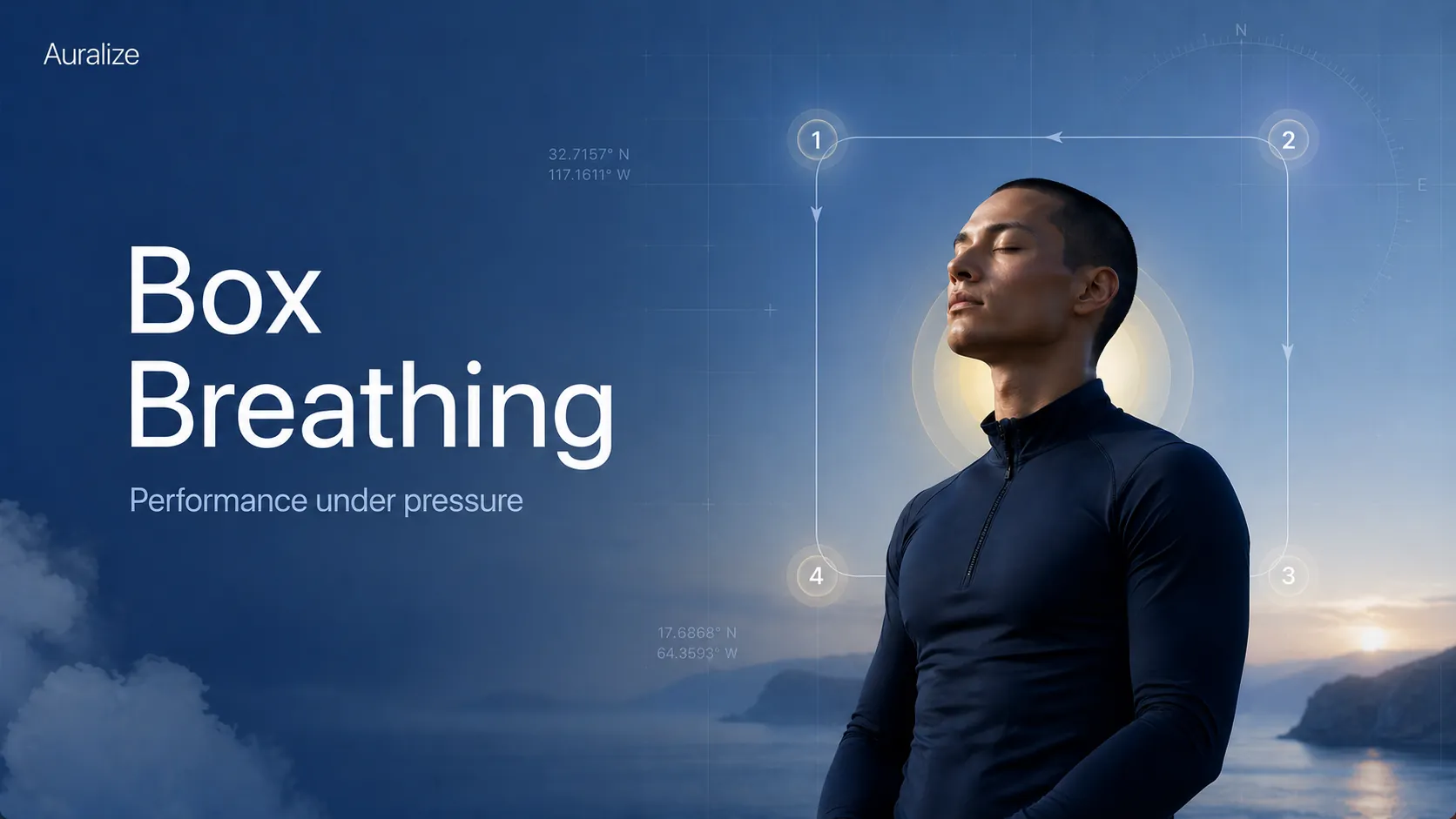
Box breathing is a four-phase pattern: inhale for four counts, hold for four, exhale for four, hold for four. The four-sided symmetry — the "box" — is what gives the technique its name. Most breathing protocols bias one phase, usually the exhale. Box breathing does something different: it gives every phase the same job length, so attention has a predictable route to follow.

The box breathing cycle

The square is the memory aid: move around one side per phase, keep every side the same length, then repeat.

That symmetry is not just a memory aid. The inhale gives the body air. The first hold keeps the breath from immediately collapsing into a fast exhale. The exhale shifts the system toward down-regulation. The second hold creates the moment where CO₂ starts to become noticeable. One cycle is simple; repeated for several minutes, the pattern becomes a steady autonomic signal.

The science

Slow breathing at box breathing paces (typically 4 counts = 4 seconds, producing roughly 3–4 breath cycles per minute) consistently produces: reduced cortisol, increased heart rate variability, decreased respiratory rate, and improved cognitive performance under stress. [1] [4] The symmetrical hold phases add two effects not present in hold-free protocols: the inhale hold prevents rapid shallow breathing from re-establishing itself between cycles, and the exhale hold extends the parasympathetic signal of the exhale phase beyond the breath itself. [4]

Why the Holds Matter

The holds are what separate box breathing from ordinary slow breathing. They prevent the nervous system from escaping back into shallow, rapid cycles, and they introduce a mild CO₂ challenge. Carbon dioxide is one of the main signals behind the urge to breathe. When CO₂ rises, the body asks for the next inhale. If that signal feels urgent early, breathing tends to become faster, higher, and less efficient.

Box breathing gives that signal a safe container. The hold after the inhale teaches you not to rush into the exhale. The hold after the exhale is more challenging: the lungs are emptier, CO₂ is still being produced, and the next inhale starts to feel more valuable. When the count is mild and repeatable, that air hunger becomes trainable instead of threatening. [4]

This is why Auralize links box breathing to the CO₂ Tolerance Test. A four-second box is a useful default, but it is still a guess. A baseline score gives the app a better starting point: shorter sides if CO₂ pressure builds quickly, longer sides if your slow-exhale control is already strong. Over time, progress is not about forcing longer holds. It is about making the same interval feel calmer, then retesting before increasing the demand.

Perciavalle and colleagues (2017) tested the effect of slow deep breathing (comparable to box breathing pace) on salivary cortisol — a direct biochemical measure of stress activation — and found significant reductions following a session compared to control conditions. [1] The intervention required less than ten minutes. Cortisol, which builds during sustained stress and takes hours to metabolise naturally, responded to breathing intervention within minutes. That is the physiological basis of the "works fast" reputation.

Why It Works Under Pressure

The SEAL manual framing of box breathing as a performance tool — not just a calming tool — reflects the way the technique is used in real life. Acute stress impairs prefrontal cortex function: decision-making slows, working memory degrades, and reactive responses dominate. Slow, controlled breathing intervenes by reducing sympathetic activation and giving attention a concrete sequence to follow. [2]

Box breathing works in military contexts not because it makes people relaxed in the ordinary sense. The goal is regulated, not sedated: enough arousal to perform, enough control to think.

A 2017 study found that diaphragmatic breathing practice — structurally similar to box breathing — significantly improved sustained attention and reduced negative affect in healthy adults, with effects measurable after a single session and compounding with regular practice. [2] This is the central performance argument for box breathing: it does not simply calm you down. It helps keep cognition online while arousal is still present.

Before performance

Box Breathing Shift

5–10 min

Auralize guides you through box breathing with precise audio pacing, using your CO₂-calibrated box interval when available.

How to Scale the Count

Four seconds per phase is the standard, but it is not universal. The underlying principle is symmetrical, slow breathing — not the specific count. Some individuals find six-second counts more comfortable; others need three. The research on slow breathing broadly shows effects across a range of rates below six breath cycles per minute. [4] What matters is that all four phases are equal and the total cycle is long enough to shift autonomic balance.

The right interval should feel controlled and slightly effortful. Mild air hunger is acceptable; panic is not. If four-second sides create a manageable pull to breathe, stay there until the rhythm feels steady. If four feels easy and almost too small, try five or six. If four creates significant discomfort, start with three and build. Auralize uses your CO₂ test result to make that first choice less arbitrary.

What Changes With Practice

In a single session, measurable changes in heart rate and HRV can appear within the first few minutes of slow breathing. [5] Cortisol reduction has been measured after short breathing interventions as well. [1] Subjectively, most people notice the first effect as steadier attention: less scattered, less rushed, easier to stay with the next task.

Over weeks, the adaptation becomes broader. HRV biofeedback studies — which use slow breathing at similar paces — show resting HRV improvements after four to eight weeks of consistent daily practice. [5] [8] CO₂ tolerance can shift in the same direction: the urge to breathe arrives with less urgency, the holds feel less threatening, and the same box interval takes less effort to complete.

This is why the benefits compound. Each session produces an acute state change, but repeated practice also changes the baseline you bring into the next stressful moment. Practitioners with months of consistent breathing practice show faster autonomic recovery after acute stressors. [9]

When Box Breathing Is the Right Tool

Among the many breathing techniques with evidence behind them, box breathing became dominant in performance contexts for three reasons. First, it is teachable in under 30 seconds — the symmetry makes it instantly memorable. Second, it works in the middle of arousing conditions without requiring a quiet, controlled environment. Third, the hold phases give the user something active to do, which maintains focus during the practice. [10]

It is not always the best tool. Coherence breathing can produce larger HRV effects in controlled practice. The physiological sigh is faster when arousal is already spiking. [7] Box breathing sits between them: structured enough to train CO₂ tolerance and autonomic control, simple enough to use before a competition, presentation, difficult conversation, or sleep transition.

Build the practice

Start Your Box Breathing Practice

Auralize times each phase of the box — inhale, hold, exhale, hold — so you can focus on the breath instead of counting. Available at every time of day, with environments that match where you are.

Citations

  1. [1]Perciavalle V, Blandini M, Fecarotta P, Buscemi A, Di Corrado D, Bertolo L, Fichera F, Coco M (2017). The role of deep breathing on stress. Neurological Sciences. PMID: 27995346.
  2. [2]Ma X, Yue ZQ, Gong ZQ, Zhang H, Duan NY, Shi YT, Wei GX, Li YF (2017). The Effect of Diaphragmatic Breathing on Attention, Negative Affect and Stress in Healthy Adults. Frontiers in Psychology. PMC5455070.
  3. [3]Hopper SI, Murray SL, Ferrara LR, Singleton JK (2019). Effectiveness of diaphragmatic breathing for reducing physiological and psychological stress in adults: a quantitative systematic review. JBI Database of Systematic Reviews and Implementation Reports. PMID: 31436595.
  4. [4]Zaccaro A, Piarulli A, Laurino M, Garbella E, Menicucci D, Neri B, Gemignani A (2018). How Breath-Control Can Change Your Life: A Systematic Review on Psycho-Physiological Correlates of Slow Breathing. Frontiers in Human Neuroscience. PMC6137615.
  5. [5]Lehrer PM, Gevirtz R (2014). Heart rate variability biofeedback: how and why does it work? Frontiers in Psychology. PMC4104929.
  6. [6]Stromberg SE, Russell ME, Carlson CR (2015). Diaphragmatic breathing and its effectiveness for the management of motion sickness. Aerospace Medicine and Human Performance. PMID: 25947320.
  7. [7]Balban MY et al. (2023). Brief structured respiration practices enhance mood and reduce physiological arousal. Cell Reports Medicine. PMC9873947.
  8. [8]Dziembowska I, Izdebski P, Rasmus A, Brudny J, Magdyś M, Perkowski R (2016). Effects of heart rate variability biofeedback on EEG alpha asymmetry and anxiety symptoms in male athletes. Applied Psychophysiology and Biofeedback. PMID: 26846763.
  9. [9]Shaffer F, Ginsberg JP (2017). An Overview of Heart Rate Variability Metrics and Norms. Frontiers in Public Health. PMC5624990.
  10. [10]US Navy SEAL Mental Toughness Training Manual. References to tactical breathing (box breathing) as a performance tool under stress.
  11. [11]Grossman P, Wilhelm FH, Brutsche M (2010). A respiratory sinus arrhythmia index as a measure of cardiac vagal control during a graded emotional visual protocol. Biological Psychology. PMID: 19941933.

Auralize does not replace medical care. Breathwork should always feel safe and voluntary. Consult a healthcare professional before beginning any new respiratory training program.