Assessment
CO₂ Tolerance
This slow-exhale baseline estimates how calmly you handle rising CO₂. It shows whether stress tends to make your breathing feel rushed.
How it works
- 1. Follow the orb for 5 calm warm-up breaths.
- 2. On breath 6, take one gentle inhale when prompted.
- 3. Exhale slowly and softly without strain, then tap Stop when you need to inhale.
This is a baseline check, not a challenge. Stay seated, stop at the first clear need to inhale, and return to normal breathing if you feel dizzy or strained.
Auralize · Assessment
The CO₂ Tolerance Test
A free, guided sixty-second breath test. Get your level from Wayfarer to Summiteer and a single-phase, 10-session breath training plan calibrated to your result.
Why this matters
A live, guided CO₂ tolerance test — not another text guide.
Most CO₂ tolerance pages online are instructions you read and try to follow yourself. This is the test itself: guided pacing, a single tap to stop, a scored result, and a single-phase, 10-session plan calibrated to your baseline.
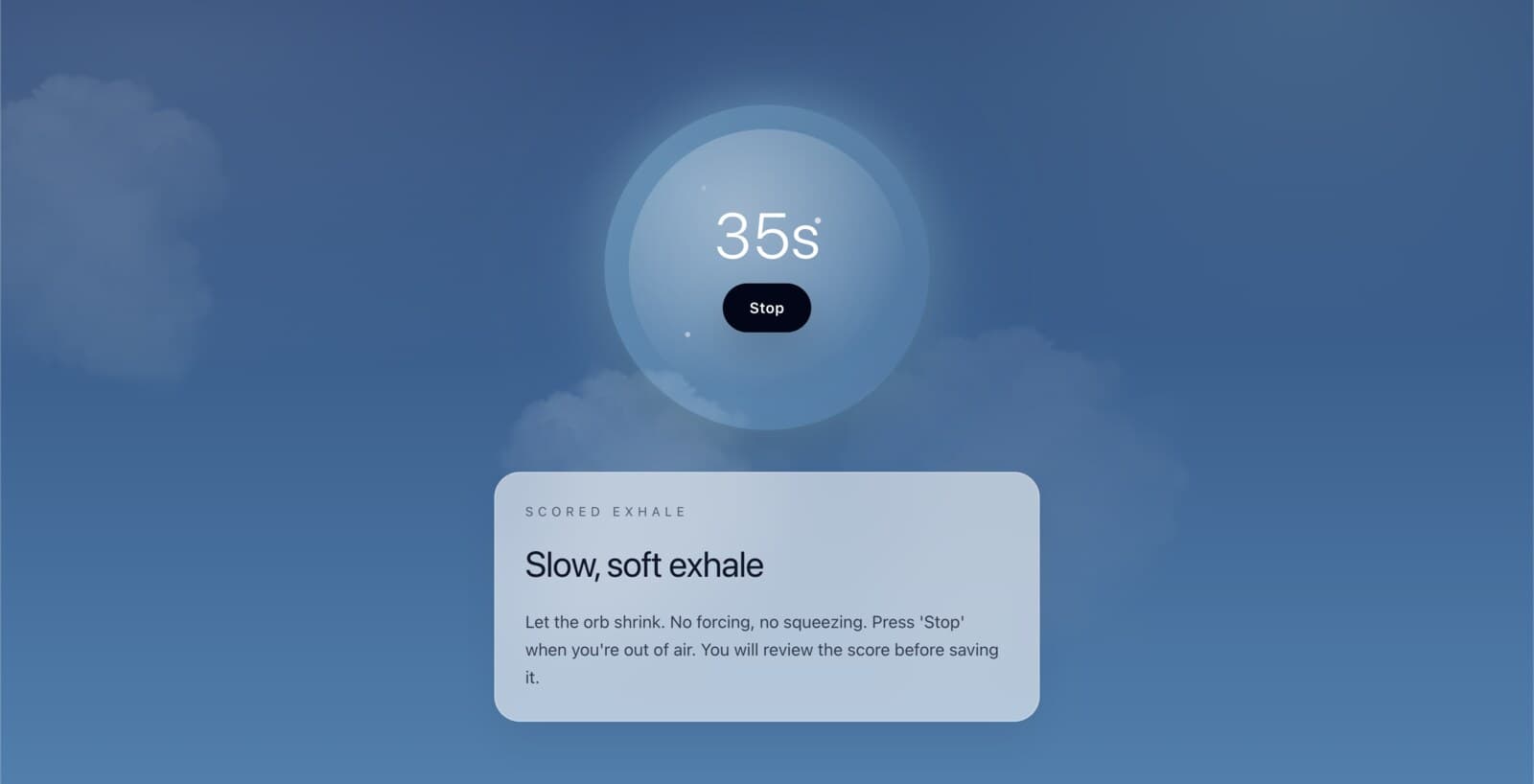
Guided pacing
Five guided warm-up breaths make the app protocol easier to repeat. They do not directly measure or fix a starting blood CO₂ level.
Single-tap stop
The exhale ends when you tap. No overshooting, no white-knuckling for an extra second, no ambiguous endpoint.
Score, level, and plan
You leave with a number, a level from Wayfarer to Summiteer, and a single-phase, 10-session program matched to your baseline.
Manual protocol
How to do the CO2 tolerance test manually.
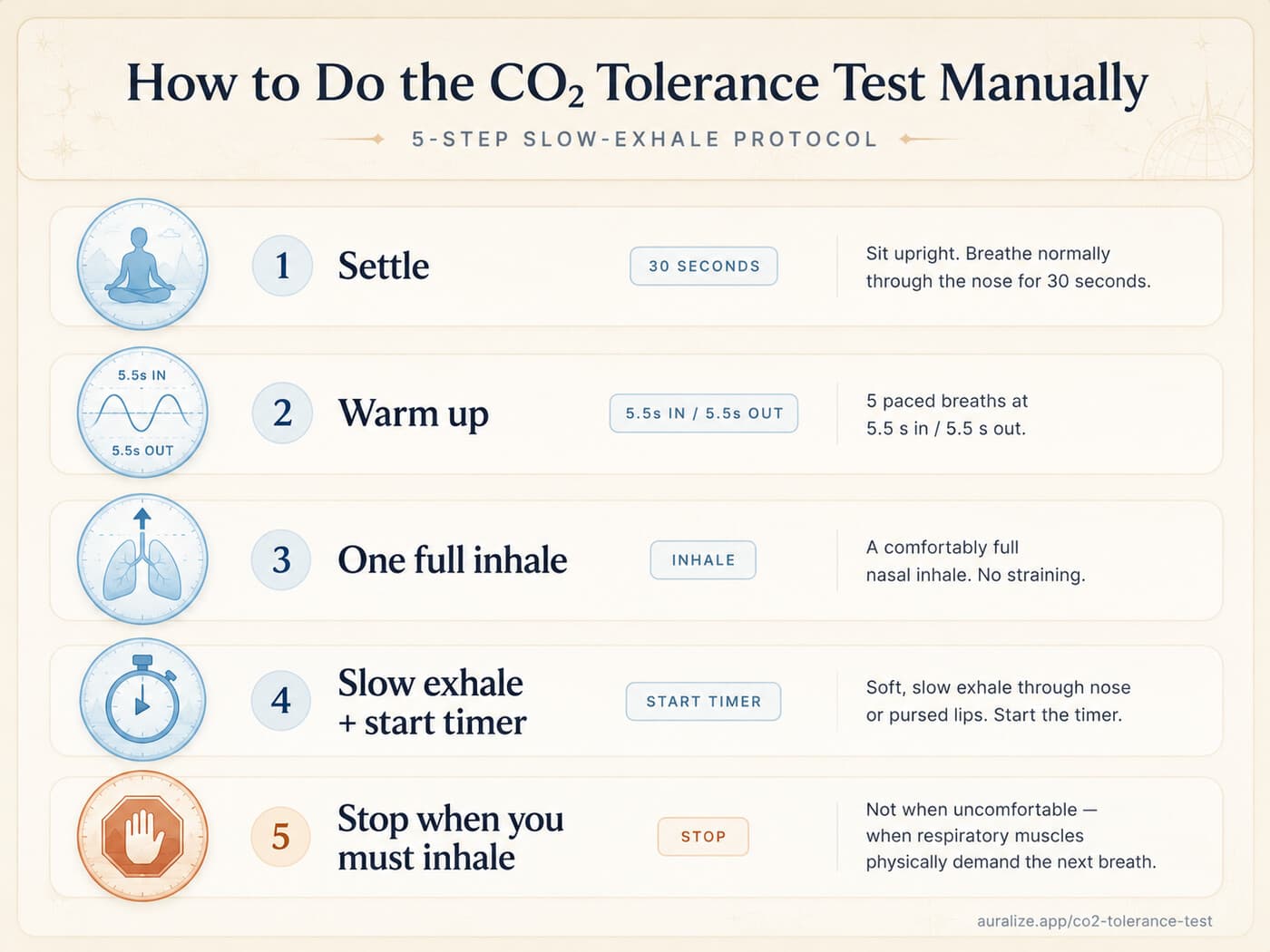
If you prefer a stopwatch and your own pacing, here is the slow-exhale CO2 tolerance test in five steps. Or use the guided version at the top of this page — the pacing, timer, stop point, and score interpretation are handled for you.
- 1. Settle. Sit upright, relaxed, with your feet flat on the floor and shoulders soft. Breathe normally through the nose for about 30 seconds. Don't deep-breathe or hyperventilate before starting — that lowers your baseline CO₂ artificially and inflates the score.
- 2. Five warm-up breaths at 5.5 in / 5.5 out. Inhale through the nose for 5.5 seconds, exhale through the nose for 5.5 seconds, and repeat five times. This standardises the app sequence, but it does not guarantee an identical blood CO₂ level across attempts.
- 3. One full inhale. On the next inhale, take a full breath through the nose. Don't force or stretch it — just a comfortably full inhale.
- 4. Slow, soft exhale + start the timer. Begin exhaling as slowly and softly as possible, through the nose or pursed lips. Start a stopwatch the instant the exhale begins. Keep it gentle — no straining, no squeezing. Just sustain the soft outflow.
- 5. Stop the timer the moment you must inhale. Stop at the first clear need to inhale, without squeezing out extra air. The duration is your Auralize controlled-exhale score. Compare it only with the same protocol under similar conditions.
Score chart
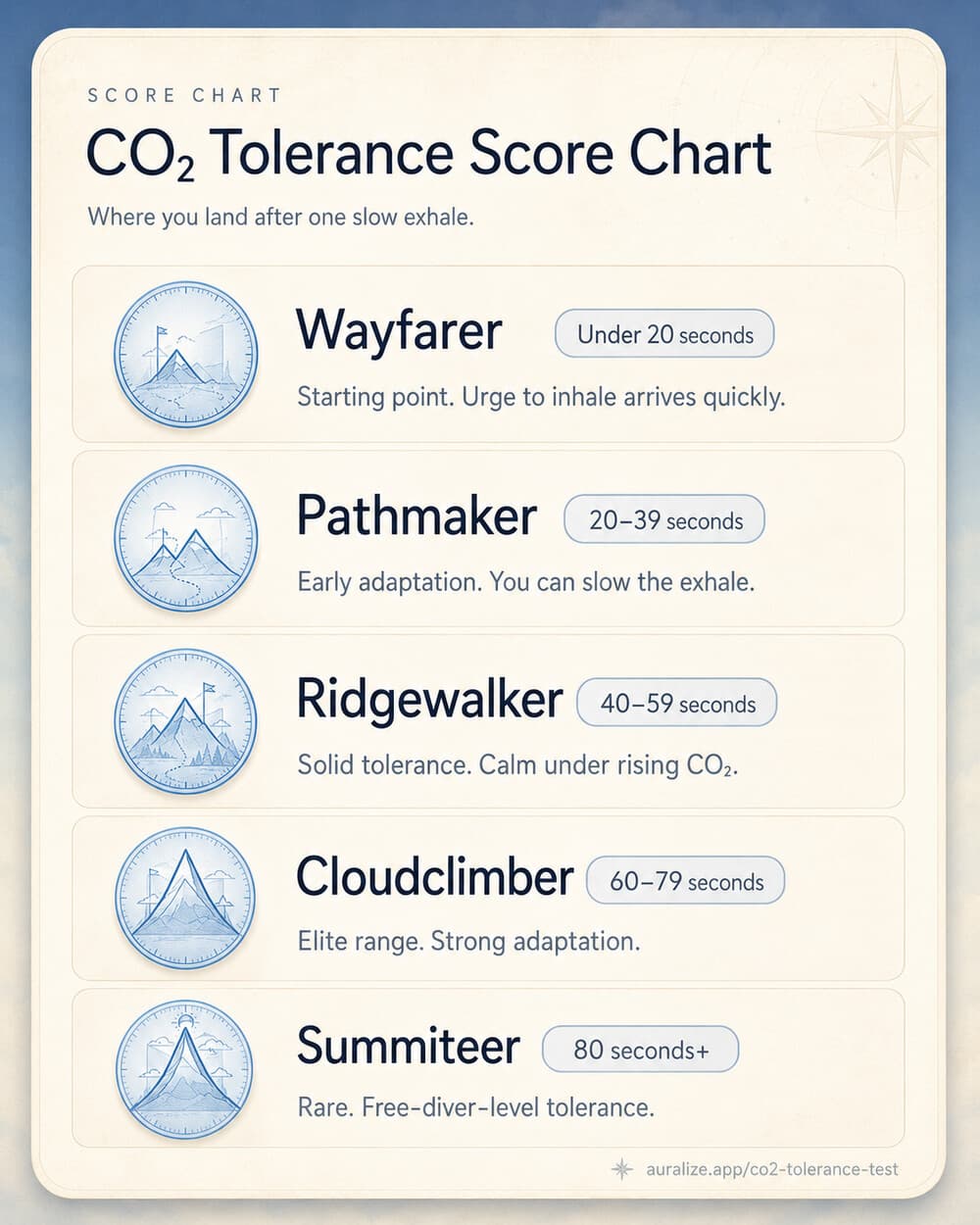
CO₂ Tolerance Score Chart
Where you land after one slow exhale. These are Auralize product bands, not validated population norms or diagnostic cutoffs. Use the score as a personal baseline and retest with the same protocol.
Wayfarer
Under 20s
Auralize level 1 for this controlled-exhale protocol.
Pathmaker
20–39s
Auralize level 2 for this controlled-exhale protocol.
Ridgewalker
40–59s
Auralize level 3 for this controlled-exhale protocol.
Cloudclimber
60–79s
Auralize level 4 for this controlled-exhale protocol.
Summiteer
80s+
Auralize level 5 for this controlled-exhale protocol.
Compare
CO₂ tolerance test vs BOLT test.
They use different tasks and produce non-equivalent scores: a controlled exhale here, and a post-exhale first-urge hold for BOLT.
The BOLT test asks you to pause after a normal exhale until the first definite urge to breathe. This page measures how long you sustain a soft, controlled exhale before you need to inhale. Neither directly measures arterial CO₂, oxygen saturation, or lung function. Auralize uses both as product baselines and may map them to training suggestions.
No validated conversion or direct repeatability comparison exists between the two Auralize protocols. Keep each test's conditions consistent and compare it only to its own history. For a side-by-side breakdown see CO₂ Tolerance Test vs BOLT Test article, or take the BOLT breathing test directly.
The science
What a controlled exhale can capture.
The timer captures performance on one repeatable expiratory-control task. Starting volume, airflow, technique, state, respiratory mechanics, and the stopping decision all affect the result.
During the test you do five guided coherence breaths at 5.5 seconds in, 5.5 seconds out. On the final breath you take one full inhale, then begin a long, soft exhale. Your score is the number of seconds you sustain that exhale before the urge to inhale arrives.
CO₂ and pH contribute to respiratory drive, but this browser test does not sample either one. The result also depends on expiratory flow and technique, so “CO₂ tolerance” is an Auralize training label rather than a laboratory measurement. Read the physiology and limitations guide for the full distinction.
Scope + limits
What this test measures — and what it does not measure.
Honest about what a CO2 tolerance score is and isn't. Use it as a personal training baseline you can retest, not as a clinical diagnostic.
What it measures
- Controlled-exhale duration under the guided Auralize protocol.
- Exhale control — your ability to sustain a soft, paced outflow without obvious strain.
- A combined signal influenced by starting breath volume, airflow, mechanics, state, and stop timing.
- A trend you can track. Most useful when retested every two to four weeks under similar conditions.
What it does NOT measure
- Lung capacity, vital capacity, or FEV₁ — those need a spirometer.
- VO₂ max or aerobic fitness — those need a treadmill or bike protocol.
- A medical diagnosis. Not a substitute for a clinical pulmonary function test or any cardiorespiratory work-up.
- An absolute number that's comparable between people — best used to track yourself over time.
Influences on your score. Sleep, recent caffeine, recent exercise, posture, stress, time of day, and familiarity with the protocol all affect the result. Take the test under similar conditions for trends you can trust — same room, same time of day, rested, not within an hour of vigorous exercise or coffee.
Safety. For healthy adults practising relaxed breathing this test is safe — it doesn't involve holding your breath at full lung volume, only a soft controlled exhale you stop on your own terms. Skip it (or consult a clinician first) if you have uncontrolled cardiovascular, respiratory, or neurological conditions, a history of fainting with breath work, late-stage pregnancy, or are recovering from eye, sinus, or chest surgery. Never perform breath assessments while driving, swimming, or in any environment where lightheadedness could cause harm.
Frequently asked
Common questions about the CO₂ tolerance test.
What is the CO₂ tolerance test?
Auralize's CO2 tolerance test times one soft, controlled exhale after five guided warm-up breaths. The score measures performance on that proprietary protocol; it does not directly measure arterial CO2, chemoreflex sensitivity, lung function, or aerobic fitness. You can take it online above without signing up.
Is the CO₂ tolerance test the same as the BOLT test?
No. BOLT times a pause after a normal exhale until the first definite urge to breathe. This test times a continuous, gentle exhale. Auralize ships both as separate assessments and may use either as a product pacing input, but the raw scores are not equivalent and should not be converted.
Should I take the CO₂ tolerance test or the BOLT test?
Pick the slow-exhale test if you want the public Auralize controlled-exhale baseline. Pick BOLT if you specifically want a post-exhale, first-urge hold. Neither is a pure CO2 meter, and each should be compared only with past results from the same test.
What is a good CO₂ tolerance score?
There is no validated population cutoff for this proprietary controlled-exhale test. The chart maps durations to Auralize product levels so the app can describe a personal baseline and suggest training. It should not be used to label a score as medically poor, normal, or elite.
How can I improve my CO₂ tolerance?
Practice can improve performance on a controlled-exhale task through familiarity, smoother airflow, and respiratory control. Auralize may suggest paced breathing from your result, but it cannot promise a fixed physiological adaptation or timeline. Retest with the same protocol and stop any practice that causes strain or dizziness.
Is this test safe?
For healthy adults practicing relaxed breathing, yes. The test never asks you to hold your breath after an inhale — it is a soft exhale with a stop button you control. If you have respiratory, cardiovascular, or neurological conditions, are pregnant, or have a history of fainting, consult a physician before performing breathing assessments.
How accurate is an online CO₂ tolerance test?
The guided sequence standardizes pacing and timing, but the test has not been established as a clinical CO2 measurement. Starting lung volume, airflow, technique, state, and the stopping decision affect the result. It is most useful as a personal app baseline taken under similar conditions.
What does the test cost? Do I need an account?
The test is free and runs in your browser. No signup required to take it. If you want to save your result, track progress over time, and unlock the matched single-phase, 10-session program, the rest of the Auralize app is one tap away.
Go deeper
Related reading.
Background science and adjacent assessments to take next.
Assessment
BOLT Breathing TestThe breath-hold variant of the same assessment.Article
CO₂ Test vs BOLT TestSide-by-side: same trait, two protocols.Article
CO₂ Tolerance TrainingThe Bohr effect and why “less” breathing helps.Article
Test at HomeStep-by-step protocol in a few minutes.Article
Coherence Breathing & HRV5.5 breaths per minute and resonance frequency.Article
Breathwork for AthletesComposure, efficiency, recovery, activation.