01
Science
Read the four athlete jobs
Composure, efficiency, recovery, priming. Understand which breath does which.
Breathwork for athletes
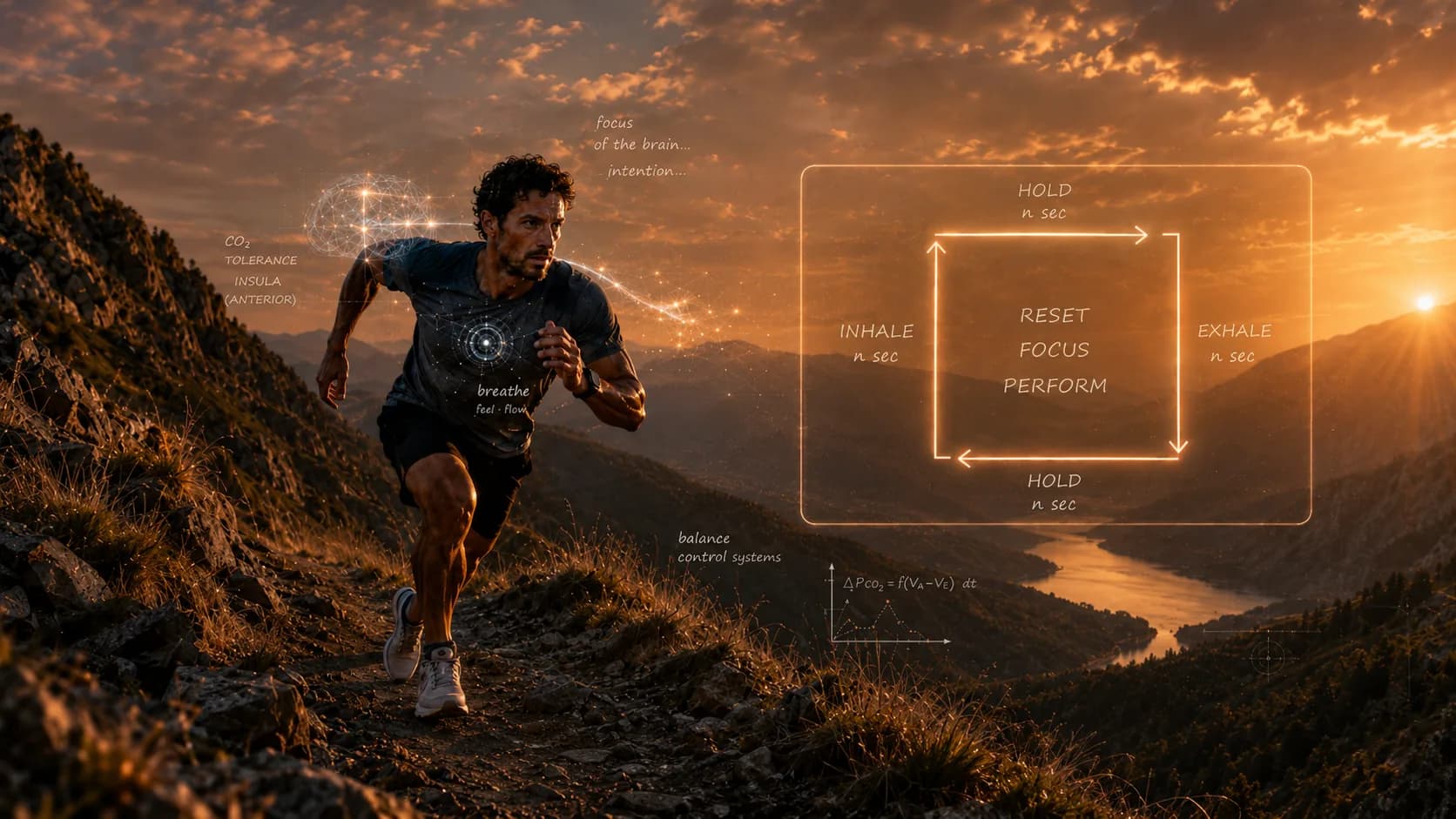
Map the performance jobs, measure tolerance and power, then start the capacity, cadence, and priming work that belongs in an athletic routine.
Begin with Day 01Day 01 · Science
Athlete breathwork gets clearer when each tool has a job: composure under pressure, oxygen-cost efficiency, recovery, or event priming.
One focused step.
Science
Read the four athlete jobs
Day 02 · Measure
CO₂ tolerance sets the pacing for control work. Power capacity sets guardrails before power-breathing or priming sessions.
One focused step.
Measure
CO₂ Tolerance and Power Capacity
Assessment · Tolerance pacing
Set the CO₂ baseline used for tolerance-focused practice.
Assessment · About 1–3 minutes
Take CO₂ tolerance test
Assessment · Power readiness
Set the power-breathing baseline used before priming work.
Assessment · 8 to 10 minutes
Take power capacity test
Day 03 · Foundation
CO₂ Capacity Builder is the controlled base layer: scaled box breathing that can support steadier pacing when training gets demanding.
One focused step.
Foundation
CO₂ Capacity Builder
Day 04 · In-motion
Cadence breathing moves the skill out of stillness and into stride, helping you coordinate breathing with the repeated rhythm of sport.
One focused step.
In-motion
Cadence breathing
Day 05 · Priming
Performance Priming Protocol is for alert energy before hard efforts. It belongs after the baselines, not before them.
One focused step.
Priming
Performance Priming Protocol
After the path
These are compact next-path options, not extra steps inside this sequence.
Beginner path · 4 days
A four-day reading and practice path for people new to breathwork. Read the map, take a CO₂ baseline, choose a first practice, then build rhythm and recovery tools.
Open path
Sleep path · 4 days
A four-day learning path for people rebuilding sleep — nasal breathing, evening wind-down, and pre-sleep breathwork.
Open path
Anxiety path · 4 days
A four-day learning path for people working through chronic or recurring anxiety. Match tools to states, drill resets, and add daily coherence.
Open path